
How much to charge for a service: how to calculate labor pricing (with free spreadsheet)
Almost every service business owner has been through this: a client asks for a quote, you look at the ceiling, do some math in your head and blurt out a number. Sometimes you win the job and find out at the end of the month that you worked for free. Sometimes you lose it because you priced high without knowing why. The problem is not a lack of technical skill, it is that nobody teaches the owner how to build a price. This guide fixes that from start to finish: how to calculate the cost of your hour of work, how to build a price with real profit, and when to use each of the three ways to price a service (BDI, markup and contribution margin).
It works for any field service: electrician, air-conditioning installer, CCTV technician, solar energy installer, pest control, internet provider, building maintenance. The logic is the same. Only the number that goes into the math changes. And at the end you can download a free spreadsheet that does all this math for you.
📊 Download the free pricing spreadsheet
It calculates the cost of your technician-hour, then applies the BDI and contribution margin automatically. You enter the labor cost (of one technician or the whole crew) and your percentages, and it builds the price, the cash price, the installment and the margin. It already does the math the right way, dividing the cost by the BDI, with no risk of you multiplying wrong.
Copy it in Google Sheets (recommended) or download it in Excel.
How do you calculate the price of a service?
The price of a service is the sum of four building blocks: the direct cost (labor and material for that job), your company's fixed expenses spread across jobs, the taxes on the invoice, and the profit you want to earn. Whoever forgets any of these blocks charges less than they should and quietly finances their own loss without noticing.
One sentence sums it up: price is not what the competitor charges, it is what covers your costs plus the margin you want. Looking at the competition tells you whether you are within the market, but the starting point is always your own numbers. Let's open up the four blocks.
Block 1: direct cost (labor + material)
It is everything that specific job consumes. The material applied (cable, refrigerant, tape, part, sensor) and the technician's work hours on that visit. The material part is easy, it is what you paid the supplier. The labor part is where almost everyone gets it wrong, because they think the cost of the hour is just the salary divided by the hours in the month. It is not. Further down we show the correct calculation of the technician-hour cost.
Block 2: allocated fixed expense
These are the costs you pay just by existing, whether you sell or not: rent, office power, internet, the salary of whoever does not go to the field, the accountant, the company vehicle, tools, management software. This amount has to be built into the price of every service, otherwise it does not pay for itself. The way to build it in is to allocate it: take the month's total fixed expense and divide it by the productive hours the crew delivers in the month.
Block 3: taxes on the invoice
When you issue the service invoice, tax applies. For most small service businesses, the effective rate usually lands somewhere in the mid single to low double digits depending on your revenue bracket and local rules. Whatever the figure, the tax comes off the top of the sale price, so it has to be inside the price, it cannot be deducted from your profit afterward.
Service tax is typically charged as a percentage of the sale value of the service, not of your cost. Because it is levied on the price, it must be built into the price from the start, or it eats straight into the profit you thought you had.
Block 4: profit
Profit is what is left for you after covering costs, expenses and taxes. It is not "whatever is left at the end of the month", it is a percentage you decide and put inside the price on purpose. Without that line, your company only breaks even, and breaking even does not pay for investment, reserves, or a real salary for yourself.
How to calculate the technician-hour cost step by step
Before charging by the hour, you need to know how much your hour costs. This is the number one mistake of anyone who prices by guessing: dividing the salary by the roughly 220 hours in a month and thinking that is the cost. It is not, for two reasons. First, the technician costs much more than the salary (there are payroll charges, paid leave, benefits, mandatory contributions). Second, they do not produce 220 hours, because part of the time is travel, lunch, coffee, rework and idle time.
The correct calculation has four steps. Let's use an example of a technician with a monthly salary of $2,500.
| Step | What goes in | Example |
|---|---|---|
| 1. Base salary | What is on the payslip | $2,500 |
| 2. + Payroll charges | Contributions, paid leave, benefits, provisions (typically 60% to 80% on top of the salary in a formal employment regime) | + $1,750 (70%) = $4,250/month |
| 3. Real productive hours | Not the 220h. Take out travel, lunch, idle time. You are left with around 6 useful hours per working day | ≈ 132 hours/month |
| 4. Technician-hour cost | Total cost ÷ productive hours | $4,250 ÷ 132 = $32.20/hour |
See the size of the mistake: the naive "per hour" salary would be $2,500 ÷ 220 = $11.36. The real cost of the hour is $32.20, almost triple. Anyone charging based on the $11.36 is paying to work. And that is only the cost of the hour, still without fixed expense, tax and profit on top. That is why the next step is to decide which method to use to turn cost into price.
The 3 ways to price: BDI, markup and contribution margin
There are three classic methods to turn cost into a sale price. They do not compete with each other, each one fits a situation. Markup is the everyday one (a common service quote). BDI is the one for installation and construction work (contract jobs). Contribution margin is the decision tool (knowing whether a job is worth taking and what your break-even point is). Let's open each one up with a formula and an example, and at the end a table tells you when to use which.
What is markup and how do you calculate it?
Markup is a multiplier you apply on the cost to reach the sale price, already covering fixed expenses, taxes and profit all at once. It is the most used method for everyday service quotes, because it is fast: you calculate the multiplier once and apply it to every quote.
The formula for the markup divisor is:
Markup = 1 ÷ [ 1 − (%fixed expenses + %taxes + %profit) ]
All percentages on the sale price, in decimal form.
Example. Suppose fixed expenses represent 20% of revenue, taxes 10% and desired profit 15%:
| Item | % |
|---|---|
| Fixed expenses | 20% |
| Taxes | 10% |
| Desired profit | 15% |
| Total | 45% (0.45) |
| 1 − 0.45 | 0.55 |
| Markup = 1 ÷ 0.55 | ≈ 1.82 |
Done. If the direct cost of a service (labor + material) came to $200, the sale price is $200 × 1.82 = $364. That price already covers the fixed expenses, the taxes on the invoice and the 15% profit. Notice that multiplying the cost "by 2 off the cuff" would give $400, and anything below 1.82 means you are eating your own profit. That is why the multiplier has to come from math, not from habit.
What is BDI and how do you calculate it?
BDI stands for Benefits and Indirect Costs. In plain terms: it is everything that has to be inside the price beyond the direct cost of the service (taxes, company expenses that do not show up on the job's bill, and your profit). It is the method the Dominex system uses to build the price of quotes and proposals, especially for installation and construction work. If you install air conditioning, build a solar plant, do network infrastructure or an electrical retrofit, BDI is your language.
Here comes the point almost everyone gets wrong, and the one that gives our method its authority: with BDI you do not add the percentage to the cost, you divide the cost by a factor. That is exactly how Dominex calculates it. Look at the formula the system uses, it is simpler than it looks:
BDI = (100 − taxes% − administration% − profit%) ÷ 100
The result is a factor (a number between 0 and 1). Then: Price = Total cost ÷ BDI.
Let's do an example. Suppose taxes of 10%, administration expenses (the company's indirect costs) of 12% and desired profit of 15%:
| Component | % |
|---|---|
| Taxes on the invoice | 10% |
| Administration / indirect costs | 12% |
| Desired profit | 15% |
| Total | 37% |
| 100 − 37 | 63 |
| BDI = 63 ÷ 100 | 0.63 |
Now you just divide the cost by the factor. If the total cost of a service came to $100, the price is $100 ÷ 0.63 = $158.73. That price already covers the 10% tax, the 12% administration and the 15% profit, all calculated on the sale price (which is the right way, as we explain further down in the myths section).
What goes into the "total cost"
In the Dominex method, the total cost that goes into the division is the sum of three things:
- Labor for that service (remembering the real hourly cost, not the raw salary).
- Materials applied (parts, refrigerant, cable, supplies).
- Travel, which is the distance in kilometers times your cost per kilometer (km × cost per km). A job far away is expensive and has to go into the math.
Cash and installments
After reaching the price, the system also calculates the two payment options:
- Cash: price × (1 − discount%). With a 6% discount, $158.73 × 0.94 = $149.21.
- Installments: price ÷ number of installments. In 10 payments, $158.73 ÷ 10 = $15.87 per installment.
A detail for anyone who has heard of BDI in civil construction: there is indeed a longer formula for a composite BDI (used on large construction projects) that multiplies several factors for risk, insurance and warranty. But the practical method Dominex uses, which solves life for the vast majority of service businesses, is the divisor one above: fast, clear and hard to get wrong.
Good news: you do not have to do this math by hand for every quote. The Dominex system already calculates the BDI inside the quotes and proposals module, with taxes, administration, profit and travel kept separate, and it delivers the final price, the cash value and the installment. You just build the proposal straight from your phone or computer.
What is the difference between markup and contribution margin?
Markup and contribution margin look like the same thing, but they answer different questions. Markup tells you what price to charge. Contribution margin tells you how much is left from each sale to pay the fixed expenses and generate profit, and from how many services per month your company starts to make money (the break-even point). Markup is a price-building tool; margin is a decision tool.
The formula is:
Contribution margin = Sale price − Variable costs and expenses
Variable = what only exists if the sale happens (material applied, commission, tax on that invoice).
Example. A service sold for $364, with a variable cost (material + tax + commission) of $150:
| Item | Value |
|---|---|
| Sale price | $364 |
| (−) Variable costs and expenses | $150 |
| = Contribution margin | $214 (59%) |
Those $214 are what each service "contributes" to paying the company's fixed expenses. If your monthly fixed expense is $6,000, you need $6,000 ÷ $214 ≈ 28 services per month just to break even (break-even point). From the 29th onward, it is profit. This is the reading that markup alone does not give you, and that is why it pays to master both.
Comparison table: when to use each one
| Method | What it does | When to use it | Question it answers |
|---|---|---|---|
| Markup | Multiplies the cost to reach the price already with expense, tax and profit | Everyday service quote (visit, maintenance, repair, one-off job) | What price do I charge now? |
| BDI | Divides the total cost by a factor to build in tax, indirects and profit at once | Installation, construction and proposal built in the system (the method Dominex uses) | What price already with tax, indirects and profit? |
| Contribution margin | Shows how much each sale contributes after the variables | Deciding whether a job is worth taking, finding the break-even point, comparing services | Is it worth it? From how many per month do I profit? |
📊 Don't want to do this math by hand?
The free Dominex pricing spreadsheet already has the hourly cost, BDI and contribution margin ready. You fill in your numbers (including the total labor cost when the service is done by more than one person) and it calculates the price, the cash value, the installment and the margin on the spot, dividing the cost by the BDI the right way. The percentages (taxes, expenses and profit) go in as % of the price.
Copy it in Google Sheets (recommended) or download it in Excel.
The math myth: multiplying is not the same as dividing
Here is the mistake that makes the most business owners work for free without noticing, and almost nobody tells you about it. There is a huge difference between multiplying and dividing when building a price. The two give similar numbers, but one gives you real profit and the other gives you a profit that is only for show. Let's use nice round numbers.
The 50% mistake: markup is not margin
Your cost is $100 and you want to "earn 50%". What almost everyone does is multiply by 1.5:
$100 × 1.5 = $150. "There, 50% profit."
Wrong. You do not have 50% profit. Your profit was $50, but the sale was $150. And margin (real profit) is measured on the PRICE, not on the cost. So: $50 ÷ $150 = 33%. You thought you were earning half and you earned a third. Those 17 points that vanished are what turns into a loss at the end of the month.
To have a REAL 50% margin, you do not multiply, you divide:
$100 ÷ 0.5 = $200. Now yes: a profit of $100 on a sale of $200 gives 100 ÷ 200 = 50%.
The difference between the two ways was $50 on the same service ($150 versus $200). Multiplied across all your quotes for the year, it is money vanishing from your pocket. The table below shows the size of the trap: how much you THINK you are earning (the markup you apply) versus how much you REALLY earn (the margin left over):
| Markup you apply | Math | Margin you really have |
|---|---|---|
| +20% (×1.2) | $100 → $120, profit $20 ÷ 120 | 17% |
| +30% (×1.3) | $100 → $130, profit $30 ÷ 130 | 23% |
| +50% (×1.5) | $100 → $150, profit $50 ÷ 150 | 33% |
| +100% (×2) | $100 → $200, profit $100 ÷ 200 | 50% |
Notice: to have a 50% margin you need to DOUBLE the price (100% markup), not add 50%. Whoever confuses the two always charges less than they think they charge.
The BDI mistake: adding 32% is not the same as dividing by 0.68
The same myth attacks BDI, and here it hurts even more. Say your BDI came to 0.68. What does that number mean? That taxes + expenses + profit add up to 32% of the sale PRICE (because 100% − 68% = 32%). The common mistake is to take the cost and add those 32%:
$100 × 1.32 = $132. (wrong)
The right way is to divide:
$100 ÷ 0.68 = $147. (right)
That is $15 of difference on the same service, and the $132 leaves you at a loss. Why? Think about who charges the 32%. The invoice tax is charged on the sale value, not on your cost. The salesperson's commission is on the sale. These percentages fall on the PRICE, which is the bigger number. When you multiply (×1.32), you calculate the 32% on the cost, which is the smaller number, and you collect less than you will need to pay. When you divide (÷0.68), the 32% falls on the final price, which is exactly what they will be charged on. The math balances.
In practice: whoever multiplies thinks they built in the tax and the profit, but they built in a shrunken version of them. In the end, they pay the full tax out of their own pocket and find that the planned "profit" evaporated. It is the quietest way to work for free.
A summary to never forget again: percentages of profit, tax and expense that you plan on the SALE go into the price by DIVIDING the cost, never by multiplying. Multiplying looks the same, but it always charges less than you needed.
The good news is that you do not have to remember this rule under the pressure of a quote. The free pricing spreadsheet (copy it in Google Sheets or download it in Excel) and the Dominex system already do the math the right way, dividing the cost by the BDI, with no risk of you getting it wrong and finding out about the loss only at the end of the month.
How much should you charge per hour of service?
This is the most typed question of all, and the direct answer is: take the cost of your technician-hour (which we calculated above, $32.20 in the example) and apply the markup. With the 1.82 markup from the earlier example, the sold hour comes to $32.20 × 1.82 ≈ $58.60 per hour. That is the hourly price that covers cost, fixed expense, tax and profit. Charging below that is a conscious decision to accept a smaller margin, it cannot be out of ignorance.
There is no "national table" for how much to charge per hour, because the numbers change by region, by technical level and by each company's structure. What exists is the method: calculate your hourly cost, apply your markup, compare with the local market to check that you are within range. Anyone who gives you an hourly number without asking about your costs is guessing.
Examples by segment: electrician, air conditioning, CCTV, solar, pest control
The method is the same for everyone, what changes is what goes into the math. See how each type of provider adapts it:
- Electrician: a common service (swapping a breaker, installing an outlet) uses markup on the hourly cost + material. A full electrical retrofit of a building, on the other hand, is a construction job, so it uses BDI. The risk of electrical work can go in as a component of the BDI or as a hazard premium in the hourly cost.
- Air-conditioning installer: a maintenance visit or a refrigerant recharge is markup. A VRF installation with infrastructure is a construction job, so it uses BDI. The refrigerant and supplies go in as variable cost (important in the contribution margin). For HVAC companies, it is worth knowing the Dominex refrigeration software, which organizes work orders, equipment and quoting in one place.
- CCTV / electronic security technician: maintenance and patrols are markup; the design of a camera system with cabling is BDI. Cameras, DVR and cable are strong variables, so the contribution margin is your best friend for knowing whether the project closes.
- Solar energy installer: installing the photovoltaic system is a classic BDI construction job (structure, specialized labor, work-at-height risk, deadline). Recurring operation and maintenance (O&M) uses markup.
- Pest control: a one-off job is markup; the monthly maintenance contract is priced by the contribution margin (you want to know how much each contract contributes to covering the fixed costs). Chemical products are the variable cost.

Common mistakes that melt your margin
These are the leaks that make the owner work hard and end up with nothing left:
- Using the raw "per hour" salary. Forgetting payroll charges and unproductive hours makes you charge a third of the real cost, as we saw.
- Not building in the fixed expenses. Rent, vehicle and accountant do not pay for themselves. If they are not in the price, they come out of your pocket.
- Forgetting the invoice tax. The tax comes off the top of the sale price, not off what you imagined was profit.
- Giving a discount without knowing the margin. "10% off" sounds like little, but if your margin was 15%, you just gave away two thirds of the profit on that sale.
- Charging the same as the competitor. Their cost structure is not yours. Copying the price is copying their loss without knowing it.
- Not charging for travel. The technician's hour in the vehicle costs the same as the hour of work. A far-away job with no travel fee burns margin.
- Quoting from your head and not recording it. Without a history of how much each service cost, you never correct the price. That is why it pays to quote in a system, with the number coming from the real cost.
How to put this into practice day to day
Knowing the theory is half the road. The other half is applying it to every quote without going back to guessing. That is where a management system helps: you register the hourly cost and the markup once, and every proposal already comes out with the right price, with BDI when it is an installation, and with the material pulled from stock. The technician closes the work order on the phone in the field, with a photo and a signature, and the quote becomes a work order, which becomes an invoice, with no rework.
Dominex brings together quoting, proposals with BDI, work orders in the technician's app, recurring maintenance contracts and finance in one place. For anyone doing scheduled maintenance (HVAC, elevators, pest control, CCTV), the contracts module and the maintenance plans system turn one-off jobs into recurring revenue, which is what gives your cash flow predictability.
Stop quoting by guessing
Quotes with markup and BDI, work orders on the technician's phone and finance in one place. Free 14-day trial, no card required.
Start free trialAnd don't forget the free pricing spreadsheet: make a copy in Google Sheets or download it in Excel to start calculating today.
Frequently asked questions about how much to charge for a service
How do you calculate the price of a service?
Add four blocks: direct cost (labor + material for that service), allocated fixed expense, taxes on the invoice and the desired profit. In practice, calculate the technician-hour cost, add the material, and apply a markup to cover expense, tax and profit at once. For a construction job or a large installation, use BDI instead of markup.
What is BDI and how do you calculate it?
BDI (Benefits and Indirect Costs) is what goes into the price beyond the direct cost: taxes, the company's indirect expenses and profit. In the method the Dominex system uses, the BDI is a factor: BDI = (100 − taxes% − administration% − profit%) ÷ 100. Then, Price = Total cost ÷ BDI. Example: taxes 10% + administration 12% + profit 15% = 37%, so BDI = 0.63, and a cost of $100 becomes $100 ÷ 0.63 = $158.73. The total cost includes labor, materials and travel (km × cost per km).
Why divide and not multiply when charging?
Because tax, commission and profit are charged on the sale price, not on the cost. If you multiply the cost (e.g. $100 × 1.5 = $150 wanting 50%), the real margin ends up at only 33%, because $50 of profit on a $150 sale gives 33%. To have a real 50% margin you divide: $100 ÷ 0.5 = $200. Multiplying always charges less than you planned and eats your profit without you noticing.
What is the difference between markup and margin?
Markup is how much you add on top of the cost; margin is how much profit is left on the sale price. They are not the same: a markup of 50% (×1.5) gives a margin of only 33%, and a markup of 100% (×2) is what gives a 50% margin. Confusing the two is the most common pricing mistake and the reason for charging less than needed.
What is the difference between markup and contribution margin?
Markup is a multiplier that sets the sale price already covering expenses, taxes and profit. Contribution margin is what is left of each sale after the variable costs, and it serves to decide whether a job is worth taking and to calculate the break-even point (how many services per month cover the fixed costs). One builds the price, the other supports the decision.
How much should you charge per hour of work?
Calculate the real cost of your technician-hour (salary + charges, divided by the real productive hours, not by the roughly 220h in a month) and apply your markup. In this guide's example, the hourly cost of $32.20 with a 1.82 markup results in about $58.60 per hour. There is no single national figure, there is your number coming from your costs.
What is the ideal profit margin for a service provider?
It depends on the segment and the structure, but a net profit margin between 10% and 20% is a healthy reference for service businesses. What matters is that profit is a defined line inside the price, and not "whatever is left". A margin that is too low creates no reserve and pays for no investment; one that is too high prices you out of the market.
References
- Small business support and accounting guides on service pricing and price formation (cost, markup, contribution margin and break-even point) are a solid starting point for going deeper into the concepts in this guide.
- Your local service tax rules (the rate charged on the service invoice) are defined by your city or region, so check the effective rate that applies to your business before closing your BDI or markup.
- For construction and installation work, public-works reference ranges for BDI by type of project are a useful benchmark to compare your indirect costs and profit against.
Image credits
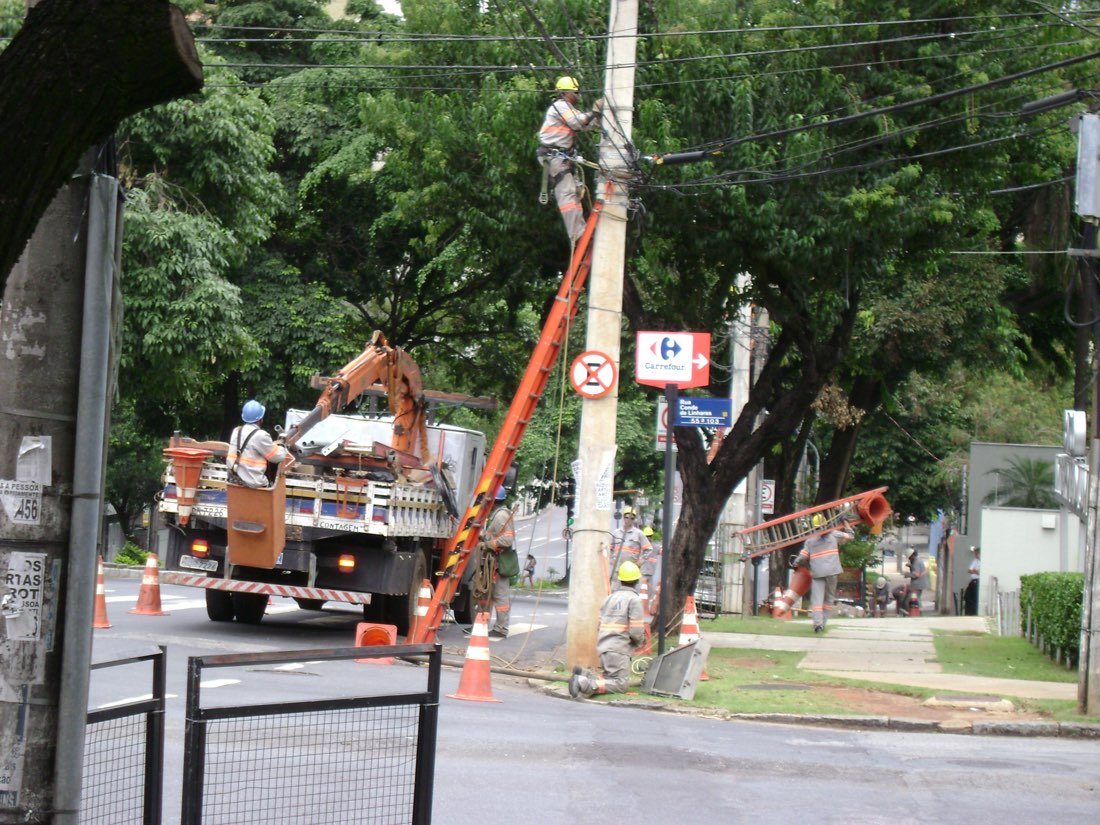
- Electricians working in Belo Horizonte (MG), Brazil: photo by Andrevruas, via Wikimedia Commons, licensed under CC BY 3.0. See original ↗
- Photovoltaic solar installation in Baleia (CE), Brazil: photo by Riosolar, via Wikimedia Commons, licensed under CC BY-SA 4.0. See original ↗
Comments (0)
Your comment goes through approval before it appears.
No comments yet. Be the first!
Ready to take your operation off paper?
Try Dominex free for 14 days and see work orders in your technician's pocket.
Start free for 14 days, no card